Geiger’s concealed camera
The Big SleepGeiger’s concealed camera is an integrated recording device in Arthur Geiger’s house, disguised within an ornament and aimed at Carmen Sternwood. Its use links a private scene to the production of a photograph that becomes a tool of extortion, while the absent plateholder leaves uncertainty about what the camera recorded and who removed its evidence.
Design and Discovery
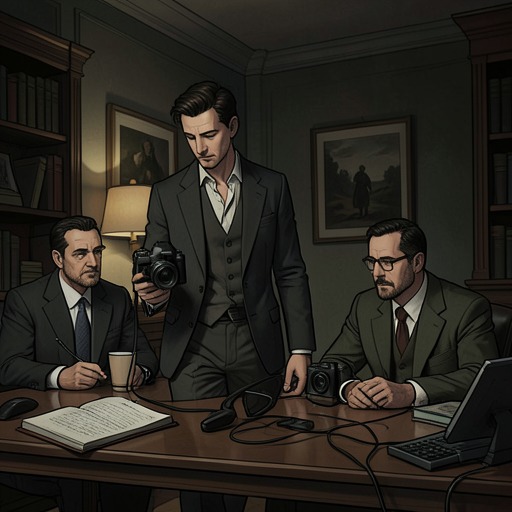
Philip Marlowe finds the camera in a device resembling a totem pole, with an eagle-like profile and a round eye that is actually the lens. It faces Carmen, who is seated in the room, and a blackened flash bulb is clipped to its side. The camera is not an incidental object in the room: its position directs the lens toward her, making the ornament a concealed apparatus for photographing her.
Earlier, a sudden flash from Geiger’s house is followed by a scream and gunshots. When Marlowe enters, he recognizes that the flash came from the camera’s bulb. The sequence connects the device to the disturbance at the house, but it does not establish exactly when a photographic plate was exposed or what image it captured.
Missing Evidence and the Photograph
After finding the camera, Marlowe checks for its plateholder. It is not in the camera, on the floor, or on Geiger’s body. The absence frustrates his attempt to account for the photographic evidence and leaves open whether someone removed it before or during the shooting. The camera can be identified, but its immediate record cannot be recovered from the room.
A photograph later delivered to Vivian Regan depicts Carmen in the chair associated with Geiger’s camera setup. The print turns private surveillance into a portable object that can be sent to the Sternwood household and used to demand money. The evidence connects the camera’s arrangement with the photograph, although the plateholder’s disappearance means the precise process by which that particular print was made remains unresolved in these scenes.
Control, Circulation, and Significance
The image’s power depends on who possesses it and who is exposed to it. Marlowe tells Carmen that the photograph is gone and that Joe Brody probably took it; he instructs her not to disclose that she visited Geiger’s house. Later, Marlowe presents Carmen’s photographs and Geiger’s coded notebook among the materials he gives to Taggart Wilde. The camera itself has already done its work as an instrument of concealed observation, while the photographs continue to move between private possession, attempted extortion, and official handling.
The public account of the killings does not disclose the Sternwoods’ connection to the case or describe the camera’s role. In that contrast, the device belongs to the hidden evidentiary chain behind the scandal: it enables an image to be made, but the missing plateholder and the later handling of the photographs make access and disclosure as consequential as the act of recording. Its concealed lens turns a domestic room into a site of surveillance, and the photograph it helps explain becomes a means of threatening the family’s privacy.